
Products
Services
Resources
Selection Guides
About
Exosomes
Exosomes are nanoscale (30–150 nm) membrane-bound extracellular vesicles of endosomal origin, distinct from larger microvesicles and apoptotic bodies, and are secreted by virtually all cell types. They transport proteins, lipids, RNA species (mRNA and miRNA), metabolites, and, in some contexts, DNA between cells, serving as key mediators of intercellular communication. Because exosome cargo reflects the physiological state of their parent cells, they have emerged as valuable biomarkers for disease diagnosis and therapeutic targets.
AAT Bioquest provides fluorescent labeling reagents, isolation kits, and detection tools for exosome research—supporting workflows from sample preparation through analysis by flow cytometry, fluorescence microscopy, and nanoparticle tracking analysis (NTA).
Exosomes mediate near- and long-distance signaling by delivering molecular cargo that can alter recipient cell behavior. They are critical to research areas such as:
- Cancer biology: Tumor-derived exosomes promote metastasis, angiogenesis, and immune evasion
- Immunology: Exosomes present antigens and modulate immune responses
- Neurodegeneration: Exosomes spread misfolded proteins (α-synuclein, tau, amyloid-β) between neurons
- Cardiovascular disease: Cardiac exosomes regulate regeneration and fibrosis
- Liquid biopsy: Circulating exosomes provide non-invasive diagnostic biomarkers
- Drug delivery: Engineered exosomes serve as therapeutic delivery vehicles
Exosome enrichment from biological samples is required before fluorescent labeling and downstream analysis. Traditional ultracentrifugation is time-consuming and can damage vesicle integrity. Precipitation-based methods offer faster exosome enrichment workflows, although they may co-isolate non-exosomal components and should be followed by appropriate validation.
- Add ReadiPrep™ reagent to sample
- Incubate and centrifuge at low speed
- Resuspend pellet in PBS
- Proceed to labeling or analysis
The isolated exosomes are compatible with downstream fluorescent labeling, flow cytometry, nanoparticle tracking analysis (NTA), and molecular analyses, and may be further purified for electron microscopy if required.
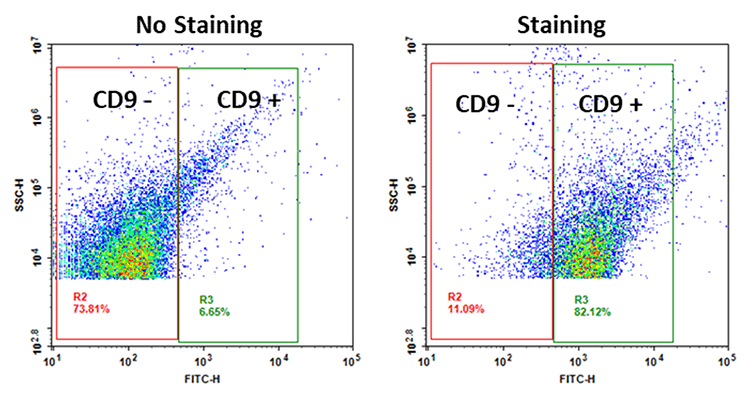
Fluorescent labeling enables exosome visualization, quantification, and tracking. AAT Bioquest offers purpose-built exosome staining kits and individual lipophilic dyes for membrane labeling.
- Flow Cytometric Kit: Uses fluorescent anti-CD9 antibody for marker-specific detection of exosome subpopulations
- Orange Fluorescence Kit: Contains Exsomight™ Orange, a next-generation lipophilic dye designed to reduce dye aggregation relative to conventional PKH and DiI dyes
Fig. 2
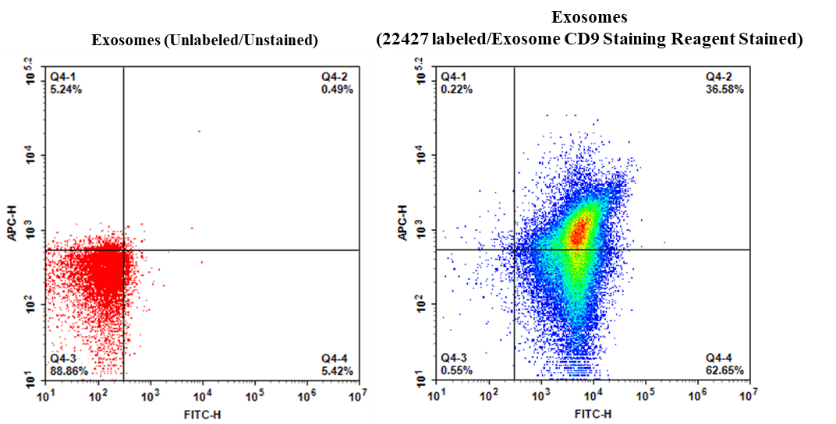
Co-staining of CHO-K1-derived exosomes. Exosomes were isolated from CHO-K1 cells using the ReadiPrep™ Exosome Isolation Kit (Catalog Number 60204) and subsequently labeled with the Cell Navigator™ Exosome Fluorescence Staining Kit (Catalog Number 22427). Following this, exosomes were further stained using the Cell Navigator™ Flow Cytometric Exosome Staining Kit (Catalog Number 22426). Fluorescence signals were acquired using an ACEA NovoCyte flow cytometer, with FITC detection for CD9 staining (Catalog Number 22426) and APC detection for Exsomight™ Orange labeling (Catalog Number 22427).
Fig. 3
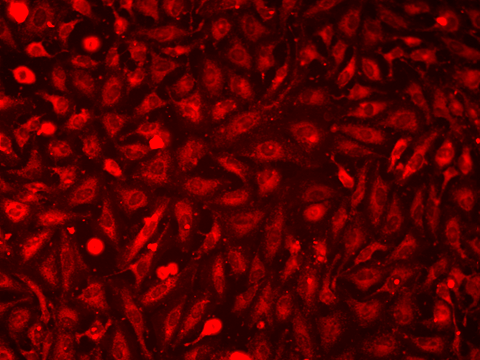
Endocytosis of CHO-K1-Derived Exosomes in HeLa Cells. Exosomes were isolated from CHO-K1 cells using the ReadiPrep™ Exosome Isolation Kit (Catalog Number 60204) and subsequently labeled with the Cell Navigator™ Exosome Fluorescence Staining Kit (Catalog Number 22427). Labeled exosomes were incubated with HeLa cells, and uptake was visualized via fluorescence microscopy using a Cy5 filter.
Carbocyanine dyes (DiO, DiI, DiD, DiR) integrate into lipid bilayers via their long alkyl chains, providing stable membrane labeling for exosomes and other extracellular vesicles. Selection should be based on the instrument's laser lines and filter sets.
- DiO/DiI: Standard choices for multicolor imaging; compatible with GFP/RFP channels
- DiD: Red-shifted emission reduces autofluorescence background; ideal for tissues
- DiR: Near-infrared emission enables in vivo imaging with deep tissue penetration
- CM-DiI/CM-DiD: Thiol-reactive that retain membrane labeling after aldehyde fixation
Exosome detection is challenging due to their small size (below the diffraction limit of conventional microscopy). Because of this, multiple complementary methods are typically employed.
Conventional flow cytometers struggle to detect individual exosomes due to size limitations. However, two approaches improve detection:
- Bead-assisted capture: Exosomes bound to antibody-coated beads produce signals detectable by standard cytometers
- High-sensitivity flow cytometry: Specialized instruments (e.g., CytoFLEX, Attune) with optimized optics can detect larger EVs or bead-captured exosomes
Fluorescently labeled exosomes can be visualized by confocal or super-resolution microscopy for cellular uptake studies.
These kits label recipient cells to visualize exosome internalization and subcellular localization.
These dyes are long-term cell trackers that enable monitoring of exosome donor and recipient populations over multiple cell divisions.
This document (01.0175.240411r2) was last updated on Sat Feb 28 2026. All trademarks and registered trademarks mentioned herein are the property of their respective owners.